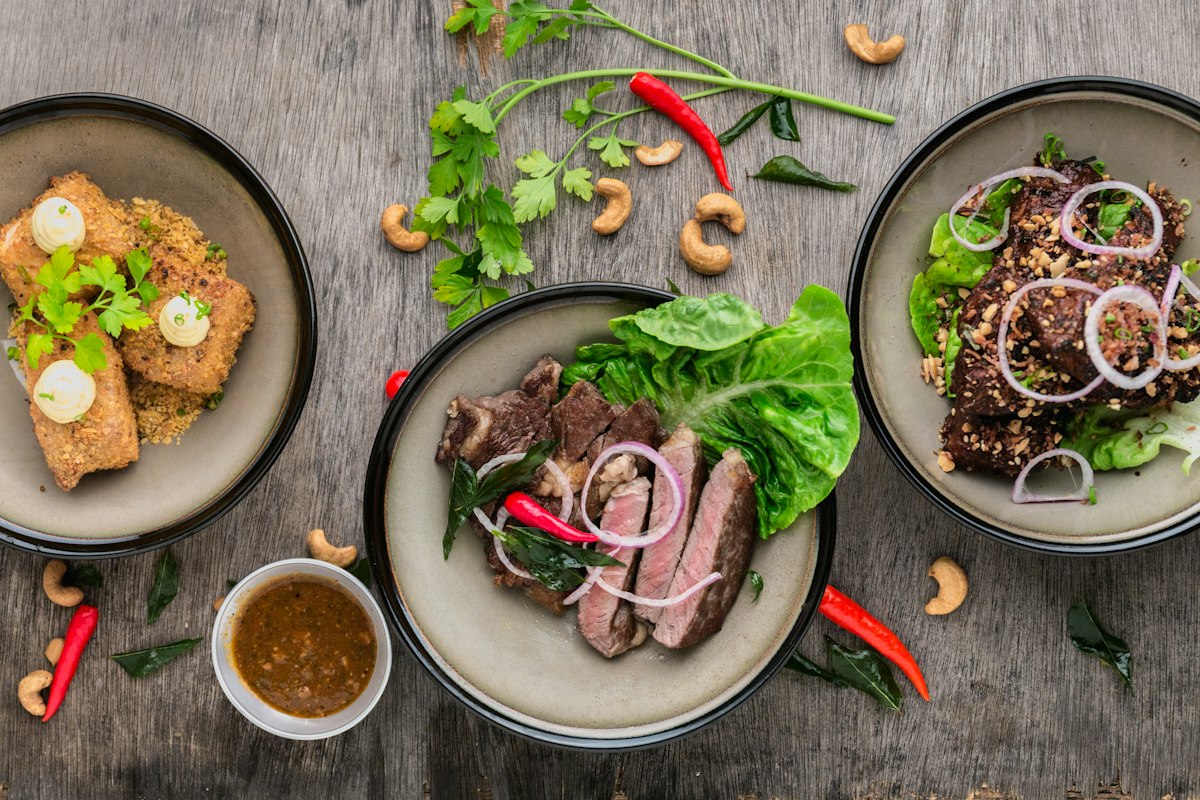
Thai food is one of the world's truly great culinary traditions — a cooking philosophy built on the balance of five fundamental tastes (spicy, sour, sweet, salty and bitter) that creates flavours more complex and layered than almost any other cuisine on earth. But arriving in Thailand for the first time and knowing where to start, what to order and how not to accidentally eat something that will incapacitate you for three days requires a little guidance.
This guide covers the 25 Thai dishes that matter most — from the classics that appear on every tourist menu to the extraordinary street food that most visitors walk past without recognising. Organised by meal type, region and budget so you can eat brilliantly from day one.
🇹🇭 Thai Food — The Golden Rule
The best Thai food is almost never in a restaurant with an English menu and photos. It is at the plastic-stool street stall with a queue of locals outside and a wok sending fire six feet into the air. Follow the smoke. That is where the real food lives.
The 25 Essential Thai Dishes
🍜 1. Pad Thai — The National Dish (Done Properly)
Pad Thai is Thailand's most internationally recognised dish — stir-fried rice noodles with egg, bean sprouts, spring onion and your choice of protein (shrimp, chicken or tofu), finished with crushed peanuts, lime and dried chilli. Done badly, which is how most tourist restaurants serve it, it is a sweet, cloying mess. Done properly at a street stall with a screaming wok and 30 seconds of proper high-heat cooking, it is extraordinary. The tell of a good Pad Thai: the noodles should be slightly smoky and have a little char from the wok. Look for the Pad Thai street stalls where the cook works fast and the queue is long.
🥘 2. Tom Yum Goong — Hot and Sour Prawn Soup
Tom Yum is Thailand's most distinctive soup — aggressively sour, spicy and aromatic with lemongrass, galangal, kaffir lime leaves, chilli and fresh prawns in a clear broth. It is genuinely one of the world's greatest soups and astonishingly different from the watered-down tourist versions served outside Thailand. The version with coconut milk (Tom Kha) is creamier, rounder and equally extraordinary. Order it in any local Thai restaurant and it will be one of the flavour highlights of your trip. Budget: ฿80–180 ($2.30–5)
🍛 3. Green Curry (Gaeng Keow Wan)
Thai green curry is made with fresh green chillies, coconut milk, Thai basil, bamboo shoots and your choice of protein — typically chicken, beef or tofu. It should be vibrant, intensely aromatic and genuinely hot — not the mild coconut sweetness that most Western Thai restaurants serve. The colour comes from the fresh green chillies, not food colouring. A properly made green curry with jasmine rice is one of Thailand's most satisfying meals. Budget: ฿80–160 ($2.30–4.60)
🌶️ 4. Som Tam — Green Papaya Salad
Som Tam is Thailand's most addictive dish — unripe green papaya shredded and pounded in a mortar with garlic, chilli, lime juice, fish sauce, palm sugar, tomatoes and green beans. It is simultaneously sweet, sour, salty and fiery, the texture crunchy and the dressing intensely flavoured. Specify "mai pet" (not spicy) if you cannot handle heat — the default is very spicy. Originally from northeastern Thailand (Isaan), it is now eaten everywhere. Budget: ฿40–80 ($1.15–2.30)
🐓 5. Khao Man Gai — Poached Chicken Rice
Thailand's answer to Hainanese chicken rice — poached chicken served over rice cooked in the chicken stock, accompanied by a clear broth and a ginger-soy dipping sauce. It sounds simple and tastes extraordinary, the chicken impossibly silky and the rice fragrant and rich. The best versions come from dedicated Khao Man Gai specialists — look for the stalls with the whole chickens hanging in the window. Budget: ฿50–80 ($1.40–2.30)

🦐 6. Pad Krapow Moo Saap — Thai Basil Stir-Fry
The Thai equivalent of fast food — minced pork (or chicken or beef) stir-fried with Thai holy basil, garlic, chilli and oyster sauce, served over rice with a crispy fried egg on top. It is the most commonly eaten dish in Thailand, ordered for lunch and dinner every day by millions of Thai people. It is fast, cheap, deeply satisfying and almost impossible to get wrong. The key ingredient is Thai holy basil — different from the Italian basil you know, with a peppery, anise note that makes the dish. Budget: ฿50–80 ($1.40–2.30)
🍢 7. Satay — Grilled Skewers
Thai satay — marinated chicken or pork grilled on charcoal skewers and served with peanut sauce and pickled cucumber — is one of the great street food snacks of Southeast Asia. The marinade includes turmeric and coconut milk, giving the meat a distinctive golden colour and gentle sweetness. Found at every night market in Thailand. Budget: ฿15–25 per skewer ($0.40–0.70)
🍝 8. Khao Soi — Northern Thailand's Signature Dish
Khao Soi is the signature dish of Chiang Mai and northern Thailand — egg noodles in a rich, coconut-curry broth topped with crispy fried noodles, served with pickled mustard greens and lime. It is one of Thailand's most extraordinary dishes and one that most visitors to Bangkok never encounter. If you go to Chiang Mai, eating Khao Soi is non-negotiable. Budget: ฿60–100 ($1.70–2.90)
🥞 9. Roti — Thai Pancakes
Thai roti is a street food dessert — thin, crispy pastry fried in butter on a flat griddle, folded and served with condensed milk, banana and/or egg. It is utterly addictive and costs almost nothing. Find the roti cart at any night market and watch the cook fold and flip with extraordinary speed. Budget: ฿30–60 ($0.85–1.70)
🍲 10. Massaman Curry
Massaman curry is Thailand's mildest and most complex curry — a long-braised, Persian-influenced dish with potato, peanuts, coconut milk, tamarind and warming spices (star anise, cardamom, cinnamon). It is rich, deeply flavoured and utterly different from the fresh, sharp curries of the south. CNN once named it the world's most delicious food. Budget: ฿90–180 ($2.60–5.20)
Street Food by Region — Where to Eat What
| Region | Signature Dishes | Best Cities |
|---|---|---|
| Bangkok | Pad Thai, Tom Yum, Pad Krapow, Mango sticky rice | Yaowarat (Chinatown), Or Tor Kor Market |
| Chiang Mai (North) | Khao Soi, Sai Oua sausage, Nam Prik Ong, Kanom Jin | Warorot Market, Sunday Walking Street |
| Isaan (Northeast) | Som Tam, Larb, Gai Yang grilled chicken, Sticky rice | Udon Thani, Khon Kaen |
| South (Phuket/Krabi) | Gaeng Tai Pla, Roti, Kanom Jeen Sato, Fresh seafood | Phuket Old Town, Krabi Town |
🥭 11. Mango Sticky Rice (Khao Niao Mamuang)
Thailand's most beloved dessert — glutinous sticky rice cooked in coconut milk, served with sliced ripe mango and a drizzle of sweet coconut cream. The combination of the rich, creamy rice and the intensely sweet fresh mango is extraordinary. Only available during mango season (April–June) when the fruit is at its peak. Budget: ฿50–80 ($1.40–2.30)
🍜 12. Boat Noodles (Kuay Teow Reua)
Tiny bowls of rice noodle soup with pork or beef, dark soy sauce, pork blood broth and fresh herbs — originally served from boats on Bangkok's canals, now found at dedicated boat noodle restaurants. The bowls are intentionally small — you order 5–10 at a time. The Victory Monument area in Bangkok has the greatest concentration. Budget: ฿15–25 per bowl ($0.40–0.70)
🐟 13. Pla Pao — Salt-Crusted Grilled Fish
A whole fish packed in a crust of coarse salt, stuffed with lemongrass, and grilled over charcoal until the skin is perfectly crispy. It is one of Thailand's greatest cooking methods — simple, spectacular and found at any seafood restaurant near the coast. Budget: ฿150–400 depending on fish size ($4.30–11.40)
🧆 14. Tod Mun Pla — Fish Cakes
Thai fish cakes made with ground fish, red curry paste, kaffir lime leaves and green beans — pan-fried until golden and served with sweet chilli sauce and cucumber relish. They are nothing like the fish cakes you know — dense, spiced, intensely flavoured. Found at street stalls throughout Thailand. Budget: ฿60–100 ($1.70–2.90)
🍤 15. Goong Ob Woonsen — Glass Noodles with Prawns
Glass noodles cooked in a clay pot with whole prawns, ginger, coriander root, garlic, oyster sauce and white pepper — a clay pot dish that is one of Thailand's most elegant preparations. The noodles absorb all the prawn flavour and the result is extraordinary. Found at mid-range Thai restaurants rather than street stalls. Budget: ฿180–350 ($5.20–10)
The 10 Thai Dishes You Absolutely Cannot Miss
Top Pick
Must Try
Night Market
Dessert
Breakfast
What to Drink in Thailand
🧋 Thai Iced Tea (Cha Yen)
Strongly brewed black tea sweetened with condensed milk and poured over ice — bright orange, intensely sweet and utterly refreshing in the heat. Found everywhere at ฿20–40 ($0.57–1.15). The equivalent is Thai iced coffee (Oliang) made with dark robusta coffee. Both are extraordinary on a hot afternoon.
🍺 Chang and Singha
Thailand's two main domestic beers — both lagers, both cheap (฿60–80 / $1.70–2.30 at 7-Eleven, ฿80–150 in a restaurant). Chang is slightly sweeter, Singha slightly drier. Both are perfect with spicy food. Leo is a third option — lighter and often the cheapest. Always cold, always available.
Thailand Food Safety — Practical Guide
| Food Type | Safety Level | Notes |
|---|---|---|
| Street food from busy stalls | ✅ Generally Safe | High turnover = fresh food. The freshness is the safety indicator |
| Night market cooked food | ✅ Generally Safe | Eat freshly cooked, avoid pre-made food sitting in the heat |
| Raw salads (Som Tam etc) | ℹ️ Some risk | The lime and chilli help but some people's stomachs react |
| Ice in restaurants | ✅ Safe in tourist areas | Restaurant ice is commercially made from filtered water |
| Tap water | ❌ Never drink | Always drink bottled water — including for brushing teeth |
| Shellfish at beach shacks | ⚠️ Caution | Mussels and oysters at very basic beach stalls carry more risk in heat |
Seasonal Food Guide
🚫 Thai Food Mistakes to Avoid
Thai "not spicy" and Western "not spicy" are different standards. If you genuinely cannot handle heat, say "mai pet maak maak" (very very not spicy) and even then be prepared for some heat. The chilli tolerance baseline is different — a medium Thai dish would be very hot by most Western standards. Build up gradually over your first few days.
The restaurants on Khao San Road and the tourist strips near major attractions are almost universally poor value and quality compared to the street food 200 metres away. The best Thai food costs ฿50–150 ($1.40–4.30) and is served at plastic tables on the footpath. The worst Thai food costs ฿350+ and comes in a restaurant with a laminated menu.
Thai cuisine varies dramatically by region. Chiang Mai's Khao Soi, the Isaan region's grilled meats and papaya salads, and the south's seafood curries are completely different from Bangkok's food and from each other. If you only eat in Bangkok you miss most of what Thai food is.
🇹🇭 Best Hotels Near Thailand's Food Scenes
All hotels →🔗 Useful Links
🌐❓ Frequently Asked Questions
Pad Krapow (Thai basil stir-fry with minced meat and a fried egg) is the most commonly eaten dish day-to-day. For tourists, Pad Thai is most recognisable. Tom Yum, green curry and Som Tam are the other essentials.
Yes — from busy stalls with high turnover and food cooked fresh to order. Look for queues of local customers. Avoid pre-made food sitting in the heat and always drink bottled water.
Jok (Thai rice congee with pork meatballs and ginger) is the definitive Thai breakfast. Moo Ping (grilled pork skewers) with sticky rice is another excellent morning street food option.
Northern Thailand's signature dish — egg noodles in a rich coconut-curry broth, topped with crispy fried noodles, pickled mustard greens and lime. Found in Chiang Mai and northern Thailand. Non-negotiable if you visit the north.
Very spicy by most international standards. Say "mai pet" (not spicy) or "pet nit noi" (a little spicy). Build up tolerance gradually — what Thai cooks consider medium is genuinely hot by most Western standards.
Best during mango season — April to June — when Thai mangoes are at peak sweetness. Available year-round but quality and price are best during peak season.
Street food and market food — ฿40-120 ($1.15-3.40) per dish. A full meal at a local market costs ฿80-150 total. Eating street food for all meals costs approximately $8-15 per day total.
📚 More Thailand Guides
👉Thailand Trip Cost 2026 — Complete Budget BreakdownRead → 👉Phuket vs Koh Samui — Which Thai Island First in 2026?Read → 👉How Many Days Do You Need in Thailand? Honest AnswerRead → 👉Thailand vs Vietnam — Which Should You Visit First?Read →🛠️ Free Planning Tools
Calculate your exact budget
Check your entry requirements
Best time to visit
What to pack for your trip
Convert to local currency
We research every destination thoroughly — honest, practical guides with no fluff, no sponsored opinions. Just real advice that helps you travel smarter.
Found this helpful? Share it! 😊
Get Free Travel Tips Every Week
Honest destination guides, money-saving tips and first-timer advice — every week.
No spam ever. Unsubscribe anytime.
📖 More Food & Asia Guides
✅ Final Verdict
Thai food is one of the world's great culinary traditions and eating your way through Thailand — from Pad Thai at dawn at a Bangkok street stall to Khao Soi in Chiang Mai for lunch to fresh grilled fish on a Koh Samui beach at sunset — is one of the most rewarding food experiences on earth. The rule is simple: follow the smoke, follow the queues and never choose a restaurant because it has a laminated picture menu in English. The best Thai food costs almost nothing and tastes extraordinary. Let your nose lead you. Start planning your trip at smarttravelplannr.com 🇹🇭